Guide
How to Succeed on FiveM as an RP Server
ThaC

Almost nobody fails because their idea was bad. They fail on hosting they chose by price, forty scripts that look like forty different games, and a support team that was two friends and a Discord channel.
Opening a FiveM roleplay server is easy. Three hundred people join on launch night because you posted in the right Discords. What happens over the following ninety days is the entire game, and the servers that survive it are almost never the ones with the most features. They are the ones that got five unglamorous things right.
Hosting is the one decision you cannot patch later
You can replace every script on your server in a weekend. You cannot fix a bad host without moving your entire community, and communities do not survive moves cleanly.
FiveM is punishing in a specific way: the server tick is effectively single-threaded for most resource work, so what matters is single-core clock speed, not core count. A 32-core machine at a low clock will feel worse than a modern 8-core at a high one. The second thing that matters is where your database lives — if MySQL is on a different machine from your server, every query in every script pays network latency, forever.
What to actually ask a host before you pay:
Which exact CPU, and what is its single-core clock — not "high performance", the model number
Is the database on the same machine, and is it NVMe rather than shared SATA
Are you being sold a dedicated slice or a shared box with unspecified neighbours
Where physically is the machine, relative to where your players actually live
What is the DDoS mitigation, and is it included or an upsell you discover during an attack
How fast is support at 3am on a Saturday — which is precisely when you will need it
Budget for hosting the way you budget for rent, not for a subscription you can cancel. It is the floor everything else stands on, and a server that stutters at peak hours loses players faster than a server with no content at all.
Your server has one interface, not forty
This is the point most new server owners genuinely do not see coming, and it is the single biggest gap between a server that looks like a product and a server that looks like a hobby.
You install a HUD from one developer, an inventory from another, a phone from a third, a banking script from a marketplace, and a job script somebody gave you for free. Every one of them is fine on its own. Together they are a mess: five different corner radii, five different fonts, five different notification styles, four different shades of "primary" purple, and a player who has to learn a new visual language every time they open a different menu.
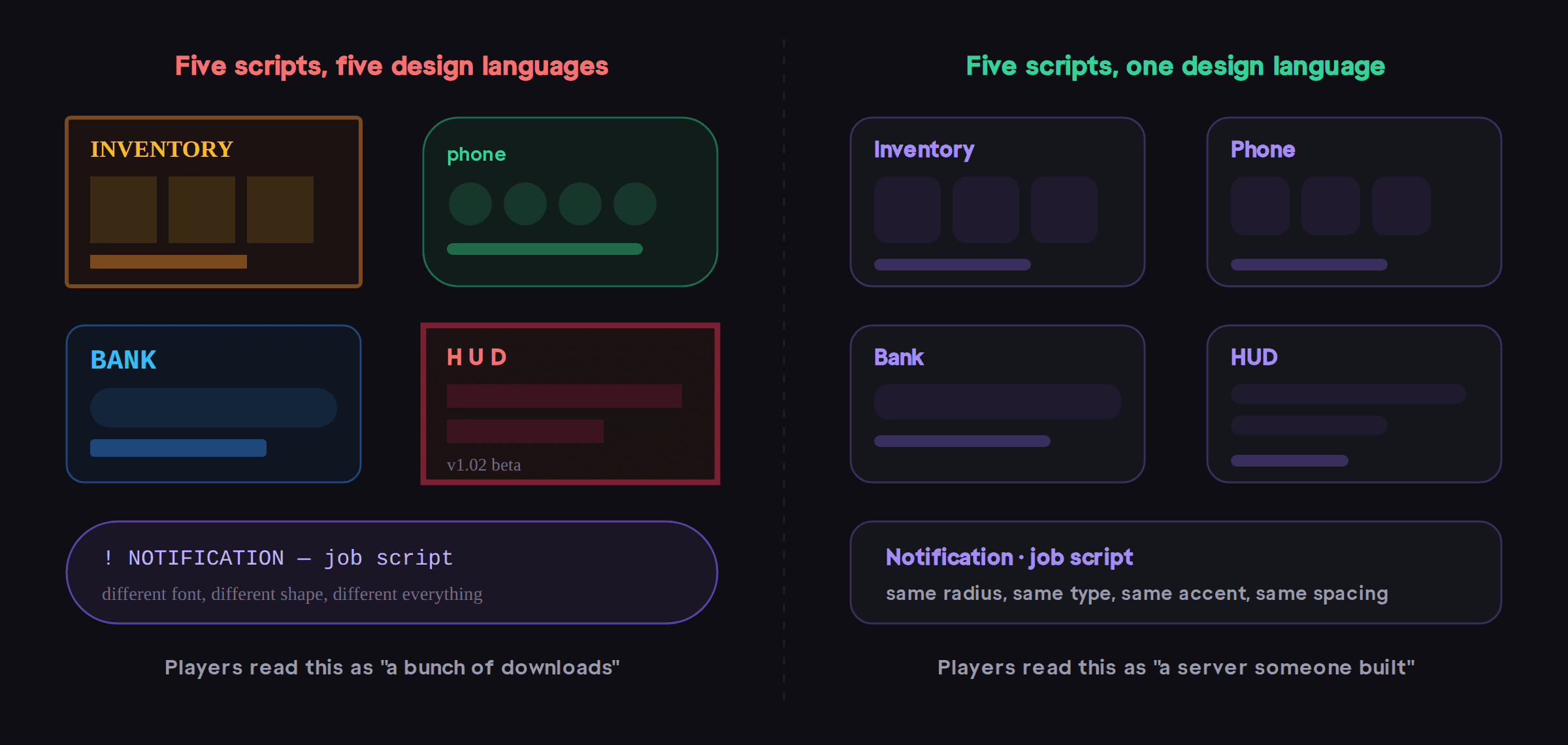
Nobody consciously notices a consistent interface. Everybody unconsciously notices an inconsistent one they just call it "this server feels cheap".
You do not need a designer to fix this. You need a rule, decided before you install anything:
Pick one accent colour and one dark background value, and reject anything that will not adopt them
Pick one corner radius and one font, and prefer scripts that expose both in config
Pick one notification system for the whole server and route everything through it
Buy from a small number of studios rather than one script from twenty different sellers
That last point is the cheat code. Scripts from one product line already share a visual language, a config style and a notification layer, so consistency is the default rather than a project. It is also why themeable accent colours and layout presets matter far more than they sound like they do when you are comparing feature lists.
Where you buy scripts, and why AI-generated ones cost more
Cfx.re runs an official protection and distribution system called Asset Escrow, managed through the Cfx.re Portal. The rule that matters to you as a buyer is direct: "Escrowed assets can only be distributed via a Tebex package." A properly protected, properly sold script comes to you through a Tebex store tied to a real creator account.
Buy there. Not because piracy is a moral question — because a leaked or repackaged script has no update path, no support ticket, and no accountability when it breaks your database at 200 players. The cheap copy is only cheap until the first incident.
The AI-generated script problem
There is now a flood of scripts that were generated wholesale by a language model, lightly renamed and put on sale. They demo beautifully. A screenshot of a menu costs nothing to produce, and the feature list is whatever the seller felt like typing.
What they tend not to survive is contact with a real server:
Server-side trust. Generated code routinely accepts values from the client that should never be trusted — item counts, prices, coordinates. That is not a bug you find in a demo, it is a bug you find when someone duplicates ten million dollars.
No thought about scale. A query inside a loop is invisible with three testers and fatal with a hundred and fifty players.
No update path. Nobody understands the code, including the seller, so a framework update means the script is simply dead.
No support. There is no one to answer the ticket, because there was never anyone who knew how it worked.
This is not an argument against AI as a tool. Plenty of good developers use it daily, and that is fine — the code still goes through someone who reads it, tests it under load and answers for it afterwards. The problem is the unreviewed output of a prompt sold as a product. The test is not "was AI involved", it is "is there a human who understands this and will answer a ticket about it".
How to tell the difference before you pay: look for real documentation rather than a feature list, a changelog with actual dates, a support channel with other customers visibly in it, and a seller who answers a specific technical question in a specific way. Ask which inventories are supported and see whether you get a list of names or the word "all".
Legal and illegal: the loop that keeps players logged in
The most common content mistake is buying twelve jobs and calling it an economy. Twelve jobs is twelve activities. An economy is when what one player does creates a reason for another player to log in tomorrow.
Roleplay servers work when legal and illegal sides of the map feed each other rather than existing in parallel. Illegal activity generates money and heat. Heat creates work for police. Police pressure creates demand for lawyers, for fences, for mechanics who ask no questions. Legal work generates the clean money that the illegal side needs to launder, and the vehicles, property and equipment everyone is working towards.
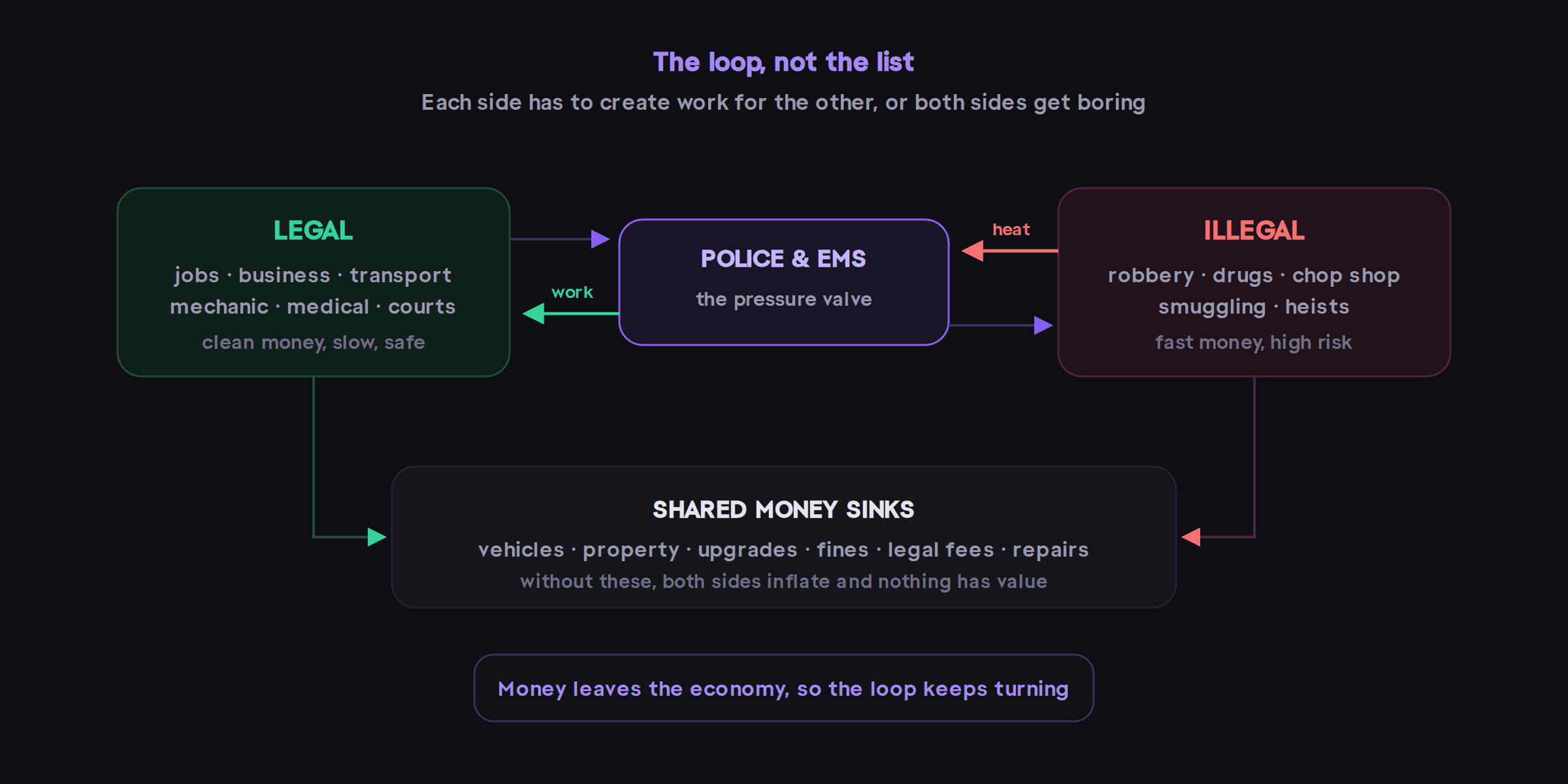
The money sinks at the bottom are the part servers skip, and they are why economies collapse: if nothing meaningful removes money from circulation, every number inflates until nothing is worth doing.
Practical rules for content
Ship both sides on day one. A server with only legal jobs is a chore simulator. A server with only crime has no one to run from, and criminals leave fastest of all.
Make illegal money faster and riskier — if crime pays worse than trucking, nobody commits crime, and your police department has nothing to do.
Gate the big things behind time, not luck. Players need a goal three weeks out.
Give police real tooling. A police force that cannot file evidence or track a case is just a job with a siren, and bored police is the fastest way to lose the criminal side too.
Build sinks before you build sources. Every server eventually has an inflation crisis; the ones that planned for it survive it.
Support is a feature, and you cannot buy it
Every script you own will eventually break, conflict with something, or need a config change at an inconvenient hour. The difference between a two-hour outage and a two-day one is entirely your staff.
Roles worth separating early, even if the same person wears two hats at the start:
Role | Owns | Failure mode if missing |
|---|---|---|
Developer | Server config, script installs, database, updates | Nobody can fix anything; every problem waits for the owner |
Admin / staff | Rule enforcement, reports, appeals | Toxic players drive out good ones and nobody notices until they are gone |
Support | Player tickets: stuck characters, lost items, connection issues | Every ticket goes to the developer, who then never develops |
Community | Discord, events, announcements, feedback loop | The server is silent between updates and players drift away |
Two things matter more than the org chart. First, written rules and written procedures — if two admins answer the same report differently, players learn the outcome is random, and that perception is very hard to undo. Second, response time targets you actually publish. "We answer tickets within 24 hours" is a promise you can keep and be judged on; silence is a promise you break constantly.
The most common cause of staff burnout is not workload. It is a support team with responsibility and no authority — people expected to solve problems they are not permitted to fix.
Launch discipline
Most servers launch too early, with a launch date announced before the work was scoped. The consequence is brutal and specific: the biggest audience you will ever have arrives on the worst version of your server, and most of them never come back to see the fixed one.
Run a closed beta with 20–40 people for at least two weeks. You are not testing whether it works, you are testing what breaks at population.
Load test before you advertise. A server that is smooth with 30 players tells you nothing about 150.
Have your rules, whitelist process and support channels live before launch night, not written in a panic afterwards.
Do not launch with an empty roadmap. Players will ask what is coming in week two on day one.
Freeze features a week before launch and spend that week only on stability. Every server owner ignores this advice exactly once.
What actually kills servers
Ordered roughly by how often we see it, and none of these are content problems:
Performance that degrades at exactly the hour the most people are online
Staff who play favourites — the fastest way to lose an entire community at once
An economy with no sinks, where a month-old player has more money than anything costs
Updates that break saves, followed by a rollback that loses a week of progress
An owner who is the only person who can fix anything, and who eventually gets tired
Silence — no announcements, no events, no visible development, for weeks at a time
Notice that "not enough scripts" is not on that list. Servers very rarely die of a thin feature set. They die of instability, unfairness and neglect.
The pre-launch checklist
Infrastructure
Host confirmed with a named CPU and high single-core clock
Database on the same machine, on NVMe
DDoS mitigation included and tested, not an upsell
Automated database backups, and a restore you have actually performed once
Scripts
One accent colour, one radius, one font, one notification system — decided in writing
Everything bought through Tebex from creators with real documentation and changelogs
Framework and inventory chosen first, then scripts checked against that choice
Every script load-tested with population, not just with staff
Content
Legal jobs live at launch, with at least one that supports a full session
Illegal activity live at launch, paying faster and riskier than legal work
Police and EMS given real tooling, not just a job and a vehicle
Money sinks in place before the economy starts running
People
Written rules, published, with a written appeal process
Support rota covering peak hours, with a published response time
At least two people who can restart and fix the server, not one
A roadmap for the first month, published on launch day
FAQ
How much should I budget for a FiveM RP server?
The two costs that matter are hosting and scripts, and hosting is recurring. Prioritise a machine with a high single-core clock and a local database over a bigger script list — you can add content gradually, but you cannot fix a slow host without moving the whole community.
ESX, QBCore or QBox — which framework should I choose?
Choose based on what your developer already knows and what the scripts you want actually support, not on which is "better". Whichever you pick, confirm every script you buy supports it explicitly. Modern scripts increasingly ship one build covering all three with auto-detection, which removes the question entirely.
How do I know whether a script was generated by AI?
You often cannot from the outside, so test the seller instead of the code. Ask a specific technical question — which inventories are supported by name, how it handles server-side validation, what happens on a framework update. Real documentation, a dated changelog and an active support channel with visible customers are stronger signals than any feature list.
Do I need both legal and illegal content at launch?
Yes. They are two halves of one loop. Legal-only servers become chore simulators; crime-only servers have nobody to run from. Police in particular need real tooling, because bored police means the criminal side loses its opposition and leaves too.
Where should I buy FiveM scripts?
Through Tebex or Rockstar Games Official UGC Marketplace, from creators using the official Cfx.re Asset Escrow system — the documentation is explicit that "escrowed assets can only be distributed via a Tebex package". That gives you an update path, a support channel and accountability, which a leaked copy cannot.
How many staff do I need to launch?
Fewer than you think, but with the roles separated. The critical rule is that at least two people can restart and repair the server, so the owner is not a single point of failure at 3am.
Building the script side of this
CodeM builds full product lines — MDTs, phones, HUDs, inventories, jobs and economy scripts that share one design language, one config style and one notification layer, on ESX, QBCore and QBox. That is the consistency problem in section 2, solved by default.
Get more details at CodeM